Random Module
Challenges of randomness
Random sampling is a fundamental capability for most simulations. The requirement that experiments also need to be deterministic makes randomness a subtle issue.
randomness vs. determinism
A truly random number source produces numbers in a sequence that cannot be predicted even in principle. A pseudorandom number source produces numbers in a sequence according to a completely deterministic algorithm, so if you know the algorithm, you can predict the next number in the sequence exactly. However, good pseudorandom number generators can produce sequences that appear indistinguishable from a truly random sequence according to a battery of rigorous statistical tests. We sometimes use the word random when we actually mean pseudorandom. Because we want simulations to be reproducible, we want them to be deterministic. But we also want statistical randomness within the simulation. Pseudorandom number generators give us both determinism and statistical randomness.
Here are the primary ways we handle this challenge in Ixa:
- We use pseudorandom number generators (PRNG or just RNG for short), which when provided with a seed number will produce numbers in a statistically random sequence—except that using the same seed will produce the same random sequence. To run a “new” simulation, provide a different seed.
- The default hash function used in the Rust Standard Library for containers
like
std::collections::HashMapandstd::collections::HashSetis nondeterministic for technical reasons that don’t apply to our application. Therefore, we provideixa::HashMapandixa::HashSet, which use a deterministic—and much faster—hash function. - Each module defines its own random number sources, so the use of RNGs in one module is somewhat isolated from RNGs used in other modules. Of course, if a module interacts with other parts of Ixa, its own random behavior can “leak” and affect the determinism of other modules as well.
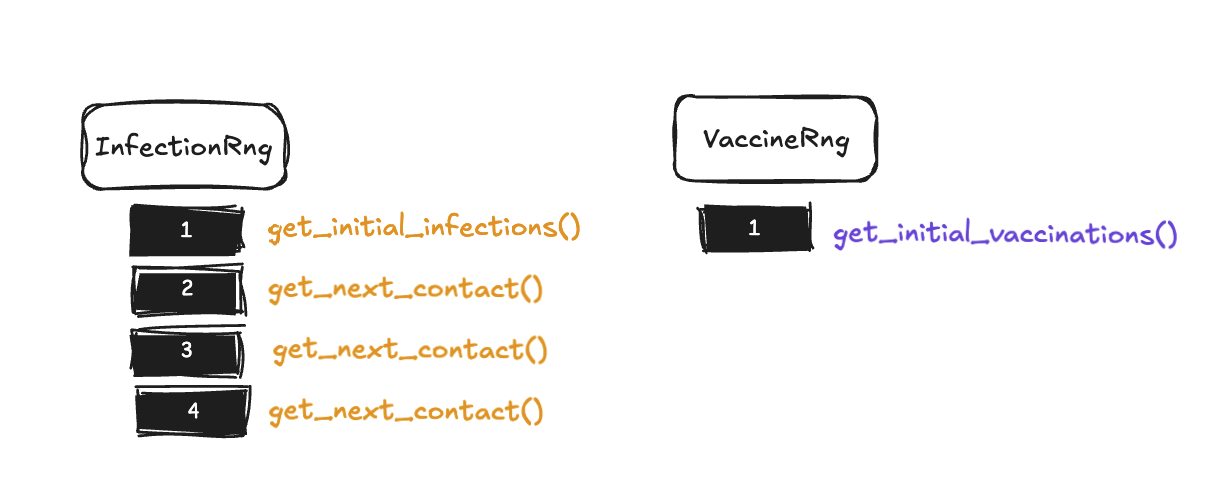
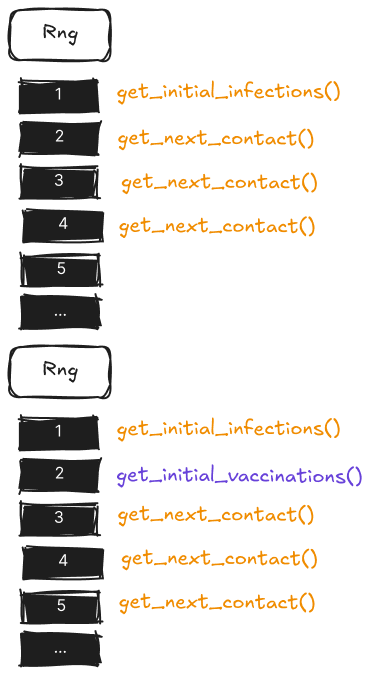 Using distinct RNGs in distinct components helps maintain simulation
reproducibility and prevents unintended interactions between independent parts
of your model. When modules share RNG streams, adding a new random call in one
component can shift the entire sequence of random numbers consumed by other
components, making it impossible to isolate changes or compare scenarios
reliably. For example, if you’re comparing two disease transmission scenarios
where only the infection rate differs, you want the same sequence of people to
be randomly selected for potential infection in both runs - but if these
scenarios share an RNG with a recovery module that makes different numbers of
random calls due to varying infection counts, the transmission module will
consume different parts of the random sequence, compromising the comparison. By
giving each module its own RNG, you ensure that changes in one module’s random
behavior don’t cascade through the entire simulation, enabling precise scenario
comparisons and reproducible debugging.
Using distinct RNGs in distinct components helps maintain simulation
reproducibility and prevents unintended interactions between independent parts
of your model. When modules share RNG streams, adding a new random call in one
component can shift the entire sequence of random numbers consumed by other
components, making it impossible to isolate changes or compare scenarios
reliably. For example, if you’re comparing two disease transmission scenarios
where only the infection rate differs, you want the same sequence of people to
be randomly selected for potential infection in both runs - but if these
scenarios share an RNG with a recovery module that makes different numbers of
random calls due to varying infection counts, the transmission module will
consume different parts of the random sequence, compromising the comparison. By
giving each module its own RNG, you ensure that changes in one module’s random
behavior don’t cascade through the entire simulation, enabling precise scenario
comparisons and reproducible debugging.
requirements for determinism
The determinism guarantee applies to repeated execution of the same model compiled with the same version of Ixa. However, you should not expect identical results between different versions of Ixa. When you make changes to your own code, it is very easy to change the simulation behavior even if you don’t intend to. Do not be surprised if you get different results if you make changes to your own code.
How to make and use a random number source
1. Define an RNG with define_rng!
Suppose we want to make a transmission manager that randomly samples a person to
become infected. In transmission_manger.rs we define a random number source
for our exclusive use in the transmission manager using the define_rng! macro,
giving it a unique name:
define_rng!(TransmissionRng);This macro generates all the code needed to define TransmissionRng.
2. Ensure the random module is initialized
Initialization of the random module only needs to be done one time for a given
Context instance to initialize all random number sources defined anywhere in
the source. It is not an error to initialize more than once, but the random
module’s state will be reset on the second initialization.
automatically with run_with_args()
This step is automatically done for you if you use run_with_args(), which is
the recommended way to run your model. This allows you to provide a seed for the
random module as a command line parameter, among other conveniences.
manually with run_with_args()
Even if you are using run_with_args(), you might still wish to
programmatically initialize the Context with a hard-coded random seed, say,
during development.
fn main() {
    run_with_args(|context, _, _| {
        context.init_random(42);
        Ok(())
    })
    .unwrap();
}
This re-initializes the random module with the provided seed.
manually on Context
In cases such as in unit tests, you can initialize the random module manually:
let mut context = Context::new();
// Initialize with a seed for reproducibility.
context.init_random(42);
3. Sampling random numbers using the RNG
The random module endows Context with
several convenient member functions
you can use to do different kinds of sampling. (The next section covers
several.) The key is to always provide the name of the RNG we defined in step 1.
We called it TransmissionRng in our example.
let random_integer = context.sample_range(TransmissionRng, 0..100);Make sure the random module’s context extension is imported if your IDE does
not automatically add the import for you:
use ixa::prelude::*;Some typical uses of sampling
Ixa provides several methods for generating random values through the context:
Sample from a Range
let random_person = context.sample_range(MyRng, 0..POPULATION);Sample Boolean with Probability
let result = context.sample_bool(MyRng, 0.4); // 40% chance of trueSample from a Distribution
Ixa re-exports the rand crate as ixa::rand. The rand crate comes with
a few common distributions.
The rand_distr and the
statrs crates
provide many more.
let value = context.sample_distr(MyRng, Uniform::new(2.0, 10.0).unwrap());`rand` crate version compatibility
As of this writing, the latest version of the rand crate is v0.9.2, but some
popular crates in the Rust ecosystem still use rand@0.8.*, which is
incompatible. Using an incompatible version in your code can result in
confusing errors that end with the tell-tale line, “Note: there are multiple
different versions of crate rand in the dependency graph”. Always using
rand that Ixa re-exports at ixa::rand will help you avoid this trap.
Custom Random Generation
For more sophisticated sampling use cases, you might need direct access to the
random number generator. In this case, we use a design pattern that ensures we
have safe access to the RNG: we pass a closure to the context.sample(…)
method that takes the RNG as an argument. If we didn’t already have
context.sample_weighted(…), we could do the following:
let choices = ['a', 'b', 'c'];
let weights = [2,   1,   1];
let choice = context.sample(MyRng, |rng|{
    let dist = WeightedIndex::new(&weights).unwrap();
    choices[dist.sample(rng)]
});